
Carmen Wittmeier, a former college instructor, describes a classroom experience in “A Child on the Tracks” (page 260 of Hot Apple Cider). While facing a group of skeptical college students grappling with the subject of global poverty, she is brought back to her own encounter with human suffering in the dark hallways of a Romanian orphanage.
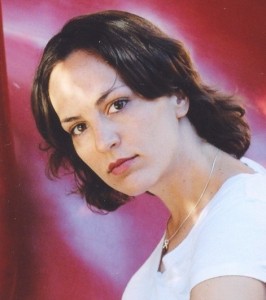 Carmen Wittmeier grew up surrounded by bookshelves (two to three layers deep) and vividly remembers the day she, her mother, and her brother exceeded their 99 book limit at the library. Her recognition of her own power to wield words began in her early teens when she forged impassioned love letters between unsuspecting victims.
Despite her delinquent beginnings, Carmen pursued literature in earnest, earning her BA in English (Honours) from the University of Calgary and her MA from the University of Alberta. A penniless graduate at the age of 23, she landed a job reporting for a national weekly magazine, The Report Newsmagazine, delving into matters of law, crime, and social justice. She simultaneously honed her skills as a writer, interviewer, and researcher for Alberta in the 20th Century, a set of history books.
Her love of classical literature eventually prevailed, and Carmen went on to teach English literature at three colleges, including Langara College in Vancouver, B.C. There, she turned her childhood fascination with children’s literature into a course called “A Flicker in the Dark: Hope and Despair in Young Adult Literature.”
Carmen has edited nearly a dozen novels and has co-written a book entitled Affirming the Birth Mother’s Journey: A Peer Counselor’s Guide to Adoption Counseling. She is currently doing freelance work in Calgary, where she resides with her husband, Rod, dedicating most of her time to ensuring that her 19-month-old daughter becomes both a book lover and a mischief maker.
Hot Apple Cider came together in a rather unusual way. What made you want to have your work in it?
I attended The Word Guild’s Write! Canada conference for the first time, and joined World Vision as a regional representative soon after. When I discovered that The Word Guild and World Vision were collaborating on this project, I jumped at the opportunity.
This book is 100% Canadian. Canadian authors, publisher, printer—everything. Is that important to you?
It is important, especially when our hockey teams are not faring well.
In her foreword for Hot Apple Cider, Janette Oke mentions that writers are often asked, “Why do you write?” How do you respond to that question?
Books have awakened parts of me, shaped me, and infused me with hope. As a small girl I would weep upon reading Oscar Wilde’s “The Happy Prince” (forcing my despairing parents to forbid me to watch the annual televised version, so overcome was I by this simple story’s beauty and tragedy).
My faith journey was shaped around the age of 12 by John Bunyan’s The Pilgrim’s Progress: I could identify with Christian’s frailty and longing, and his fear of death.
John Berryman’s The Dream Songs—a series of 385 poems that explores loss, language, lust, and the enigma of Christ—reduced me again to tears in an undergraduate poetry class and became an obsession in my graduate thesis.
Having been so moved by literature, writing became a natural step.
When did you begin writing?
My first inkling to be a writer occurred in grade three, when I wrote a riveting saga about elves riding through the merry forest on the backs of rabbits (the sort of story that would have put Tolkien to shame).
I did not complete my first elaborate project until I was of marriageable age, when my writing landed me a husband. In my early twenties, I began writing a young adult book that took eight years to complete. So much of my interior world was reflected in this book—in fact, the book wrote itself through a series of lucid dreams—that I seldom allow anyone to read it (nor will I tell people its title to this day). In a moment of weakness, I agreed to permit a young man with whom I played soccer to read it, thinking that he would never follow through. He persisted, and I handed over the manuscript with fear and trepidation. Only after the wedding did I make the grim discovery that my new husband was a Louis L’Amour fan who read more for plot than character.
What was the first thing you had published?
After finishing grad school, I applied at The Report Newsmagazine—which I had never actually read until I rifled through it in the lobby prior to my interview. After my interview, my prospective employer shook his head and said, “It would help if you actually watched or read the news, seeing as this is a newsmagazine. But you can write. Grad school didn’t destroy that part of you.” He assigned me a story, tossed me a phone book, and said, “It’s a sink or swim business.”
It took me some time to determine what my phone number was and how to turn on my dinosaur of a computer. I recall puzzling over the brown stains on the keyboard until another reporter informed me that its previous owner used to throw cans of pop at the wall in frustration shortly before the deadline each week. Thus began one of the most engaging jobs I have ever had, and I’m happy to say that I learned to swim (before the magazine itself sank).
You were one of the authors who wrote the book, Affirming the Birth Mother’s Journey: A Peer Counselor’s Guide to Adoption Counseling, co-authored by Wendy Lowe and Jutta Wittmeier. What drew you into this project?
I edited and wrote parts of the Pregnancy Care Centre’s Gamma Girls program—a program that empowers teen girls. When the Centre approached me to write a book on adoption, it felt like a natural step. Growing up, I had 14 foster siblings through the years, so I witnessed the process of adoption firsthand.
What was it like working on a book with two other people?
While Jutta and Wendy’s experience in the field of counseling is remarkable, their writing leaves something to be desired: Jutta is notorious for her use of comma splices, while Wendy has an abject fear of the period.
All joking aside, the experience was brilliant. The three of us recorded discussions about adoption and interviewed birth parents, adoptive couples, and adoptees. Using additional research sources, I turned the material into a book. We each brought our expertise to the table and hope to collaborate again in the near future.
You used to live in Fort McMurray, AB, and teach at Keyano College. One of the courses you taught was “Writing in the Workplace.” I’m curious. Does teaching something like that motivate you to write, or does it drain your energy?
Few tasks are more stupefying than teaching business writing. However, if you add Fort McMurray to the equation, as well as business professionals whose grasp of the English language is nominal, you create fodder for inspiration. For example, after having taught an unconventional lesson on idioms and phrases, I was delighted to observe my students practicing over the lunch hour.
“In your face!” a petite Japanese woman cried, fiercely shaking her finger and leering into the eyes of a much larger student.
“That woman has a bun in the oven,” a portly gentleman carefully rehearsed. “Cowabunga, dude!”
Your piece in Hot Apple Cider starts with something that happened in one of your classes, and refers to your visit to a Romanian orphanage in 2002. How did that visit affect you?
The world is a cruel place—of this I am now aware. When I hold my daughter, not yet two, I envision girls not much older than her being sold into brothels. When I add blueberries to her porridge in the morning, I ache for the mothers who have to watch their children go hungry. When I rock her in my arms, I think of the babies who are lost, thrown out, abandoned.
But I know, too, that if I turn away from injustice, I am not saving myself from pain, but depriving myself of joy. The orphans were so infused with life—their acceptance and humor and ability to live in the moment were infectious. How could I walk away from the privilege of helping them, knowing that no one else might take my place?
So I’m currently fighting injustice in tangible ways, helping to raise money for an orphanage, teaching a course on human trafficking, and using my power as a consumer to support Fair Trade initiatives.
Are you doing any other writing these days?
With a busy toddler who gets incensed whenever I dare approach my computer (unless, of course, I am downloading photographs of rabbits for her), my creative writing has been on the backburner. That said, I have managed to edit several books during her naps, and I am working on another young adult novel (one that I will allow others to read).
Many of the Hot Apple Cider authors have enjoyed promoting the book. How did you fare in this regard?
I received my fifty copies of Hot Apple Cider in the mail. I kept two copies, gave one to my mother, and another to my mother-in-law. Then, since self-promotion and sales are not my spiritual gifts, I shoved the box containing the remaining books into storage. It was a little bit like burying a talent, and I felt guilty.
Six months later, I discovered that every relative on my husband’s side had a copy of Hot Apple Cider. Then I discovered that every family friend, every neighbor, every human being remotely related to some aspect of my husband’s existence had a book. Even the neighbor’s dog had read about my experience in the orphanage.
My dear mother-in-law, it turns out, had phoned every bookstore in Edmonton to secure copies of the book and spent hours on the road picking them up, one or two at a time. Meanwhile, I had forty-some copies sitting in a box in my house, gathering dust. Yes, she managed to take care of my box of books, too.
Aside from your own piece, is there a particular piece or thought in the book that stood out for you?
Having experienced a difficult delivery—one that would have had serious repercussions had I not had medical intervention—I appreciated “Where Have All the Mothers Gone?” by Thomas Froese and Dr. Jean Chamberlain Froese.
A lot of people want to share their stories in order to help others. What advice do you have for someone who wants to write but doesn’t know how to begin?
First, toss out your tawdry romance novels. Then read. Delve into Francine Prose’s Reading like a Writer. Spend time with Hemingway (to learn how to write between the lines). Court Gerard Manley Hopkins (to better understand the musicality of language). Peer into the mind of Emily Dickinson (to see the power a single word or phrase carefully placed can wield). Take a stroll with G.K. Chesterton, Franz Kafka, and Hermann Hesse. Then, when you’re shaking with fear and awe and humility, start writing.
I’m assuming you’ve had a lot of feedback from people over the years, and feedback is great for the writer—you know someone is actually reading your words! But I’m wondering if you’ve learned anything from your readers that you could share with us?
I received an email from a Hot Apple Cider reader asking me to speak at a women’s tea in a town called Enchant. I hit the road with my mother, believing that my destination was only two hours away.
Two hours was a conservative estimate—far right conservative—and we found ourselves driving through farmers’ fields in inclement weather, seriously wondering if I would be speaking to cows, so far from human life we appeared to be.
Miraculously, we found Enchant (population 16, give or take a few), and enjoyed a profound evening. I learned, from this reader, that words transcend borders and boundaries to connect people.
What is your prayer for the readers of Hot Apple Cider?
There is so much diversity in this book, and a wealth of life experience. My prayer is that each reader will find a story that moves, and shapes, and connects.